From wool and hand-sewn clothes to the skills people passed between generations, traditional crafts offer a different way to explore Scotland’s history.
History is often associated with castles, battles and the lives of important people. But there is another way to understand the past: look at the things people made, the clothes they wore and the everyday skills they relied on.
How did people turn fleece into warm clothing? How did they make things last when replacing them was difficult? And what can the objects of ordinary life tell us about the people who used them?
These are some of the questions that make traditional crafts so interesting. They also provide a different perspective on the history of the Highlands.
Learning from the past
Fiona J. Houston’s The Garden Cottage Diaries: My Year in the Eighteenth Century explores what happens when someone attempts to recreate aspects of rural life in the 1790s. Fiona spent a year living in a basic cottage, relying on her garden and the surrounding countryside, learning traditional skills and making many of the things she needed herself.

Among other things, she experimented with making string from nettles, producing quill pens and ink, and sewing period clothing. The book brings together practical skills, folklore, gardening and observations about everyday life.
What makes this approach to history particularly appealing is its emphasis on doing rather than simply reading. It is one thing to learn that people once made their own clothes; it is another to consider the work, time and knowledge involved.
Even a seemingly straightforward object could depend on a whole chain of skills and resources. Understanding that process can change the way we look at the things we use today.
From Highland sheep to woollen cloth
Wool has a long history in the Highlands, where sheep farming and textile production were closely connected with rural life.
Knockando Woolmill in Moray offers a tangible link with that history. Parish records refer to the mill, then known as the Wauk Mill, in 1784, when William and Anne Grant were recorded as fulling wool from local sheep. Farmers brought their fleeces to be processed into cloth or knitting yarn. Over time, the mill developed and introduced machinery, but it continued to serve its local community. Today, it remains a working mill, preserving skills and machinery associated with traditional wool production.

For visitors exploring the Cairngorms and surrounding areas, places such as Knockando offer a chance to look beyond the finished product. A woollen blanket or a length of tweed represents much more than its pattern and colour. Behind it are the sheep, the people who handled the fleece, the equipment used to process it and the knowledge required to turn raw material into something useful.
The process also reminds us how closely work, landscape and the changing seasons were once connected.
Clothes with a story to tell
Clothing offers another way to explore the past. The garments people wore were shaped by the materials available to them, the work they did, their circumstances and the practical demands of everyday life.
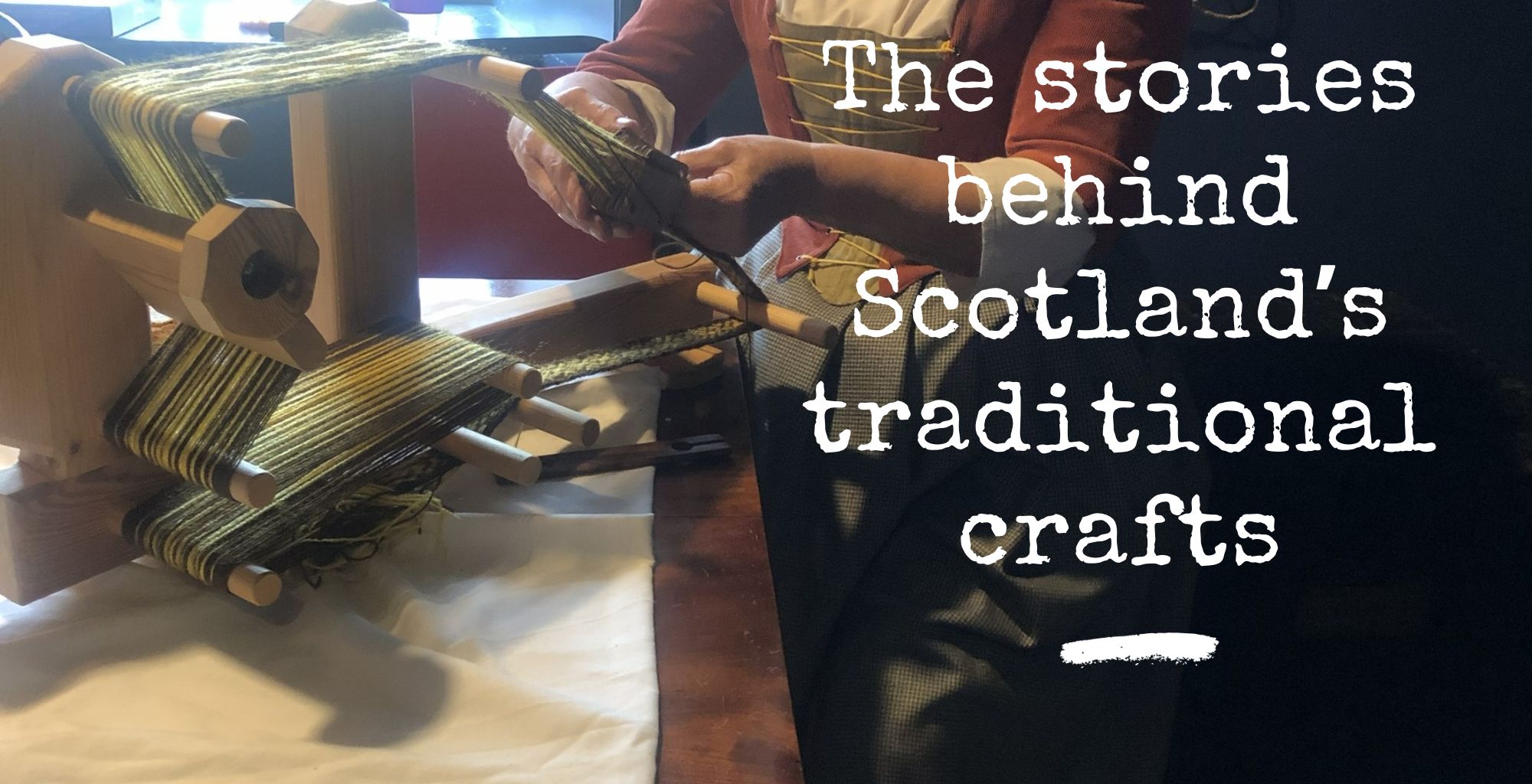
At a demonstration of spinning and weaving at Braemar Castle, I met members of the Crafty Guid Wives, who create and wear clothing inspired by the eighteenth century. What particularly interested me was their approach to making these outfits. Rather than relying on newly purchased fabric, they use spare cloth and materials found in charity shops.
Their work brings together historical inspiration, creativity and resourcefulness. It also raises an interesting question: how much can we learn about a period by trying to recreate the things people wore?
Making a garment involves decisions about fabric, shape, construction and fit. Working with reclaimed materials adds another challenge, as the maker has to adapt an idea to what is available. It is a practical reminder that making things in the past was not necessarily a matter of following a pattern and buying everything required. People had to work with the materials and resources they could obtain.
There is also a modern connection here. Reusing fabric and adapting existing clothes can be a satisfying alternative to buying something new. Although the circumstances are different, the underlying skills of making, mending and making do remain relevant.

More than a finished object
Traditional crafts are about more than the finished item. They preserve ways of working, but they also create opportunities to share knowledge and stories.
A knitting pattern might carry a family memory. A particular garment might reveal something about the person who made it. A familiar rhyme or saying might have layers of meaning that are not immediately obvious to a modern listener.
This is one of the reasons that bringing people together around crafts can be so rewarding. Conversation develops naturally while hands are busy. People exchange ideas, explain techniques and share what they know. A discussion about a piece of clothing can lead to a story about a family, a place or a way of life.
Not every historical question has a simple answer, and traditions can change as they are passed between generations. That is part of their interest: there is often more to discover than first appears.
Keeping traditional skills alive
We may no longer need to make everything we use, but learning how things were made can give us a better understanding of the materials and skills behind them.
Across the Highlands, working mills, craft groups and independent makers help keep some of this knowledge alive. Their work connects historic practices with contemporary creativity, whether through spinning wool, weaving cloth, knitting, sewing or finding new uses for old materials.
At Fraoch Lodge, these ideas are one of the inspirations behind our Highland Winter Yarn Retreat. The retreat brings people together who enjoy knitting, crochet and other textile crafts, with time to make things, exchange ideas and explore the stories behind traditional skills.
It is a chance to enjoy the simple pleasure of making something by hand, while discovering a little more about the people and places that have shaped these traditions.
Sometimes, the best way to understand history is not to stand in front of an old building or look at an object in a display case. It is to try a skill for yourself, ask how something was made and listen to the stories that have survived alongside it.
